

Every data center will eventually face a decommissioning event. Servers age out, storage arrays hit capacity limits, and networking equipment reaches end-of-life faster than most organizations plan for.
The problem? Most companies don’t think about IT asset management until they’re staring down a rack full of equipment that needs to go. By that point, data security gaps, compliance exposure, and financial waste are already baked in.
A proactive asset management strategy that starts at procurement and runs through the full lifecycle eliminates those surprises. It reduces liability, streamlines disposition, and maximizes the value you recover from retired equipment.
With hardware refresh cycles compressing and regulatory scrutiny increasing across industries, the organizations that plan ahead are the ones that avoid costly mistakes when it’s time to retire data center infrastructure.
Key Takeaways
- Most data security and compliance failures in IT disposition trace back to poor upstream asset management, not the disposal process itself.
- Every piece of data center equipment should be tagged, tracked, and lifecycle-classified from procurement, not at retirement.
- Leased and rented IT equipment carries the same data security obligations as owned assets; compressed return timelines make this easy to overlook.
- NIST 800-88 data sanitization should be triggered at every change of custody, not just final disposal.
- Engaging a certified ITAD partner months before a decommissioning event reduces rush fees, maximizes recovery value, and closes compliance gaps.
Why Data Centers Need a Different Approach to IT Asset Management
Managing IT assets inside a data center isn’t the same as tracking laptops and desktops across an office. The scale, complexity, and risk profile are fundamentally different.
Scale and Complexity
Data centers operate with hundreds or thousands of servers, switches, and storage arrays cycling through their infrastructure simultaneously. A single decommissioning event can involve dozens of racks and thousands of individual data-bearing devices. Each one carries potential compliance and security risks if mishandled.
Data Security Exposure
The data security exposure is also significantly higher. Data center equipment processes and stores far more sensitive information per device than typical office hardware. A single hard drive pulled from a production server could contain customer records, financial data, healthcare information, or proprietary business intelligence.
Regulatory Requirements
Regulatory frameworks like HIPAA, NIST 800-88, and state-level e-waste laws don’t just apply at the moment of disposal. They apply to how assets are tracked, managed, and secured throughout their entire service life, and especially during any change of custody, whether that’s an internal transfer or a full decommission.
Financial Impac
Then there’s the financial side. Depreciation schedules, warranty tracking, and residual resale value all depend on accurate, upstream asset tracking. Organizations that don’t maintain clean records lose money on equipment that still holds recoverable value, simply because they didn’t know what they had or where it was.
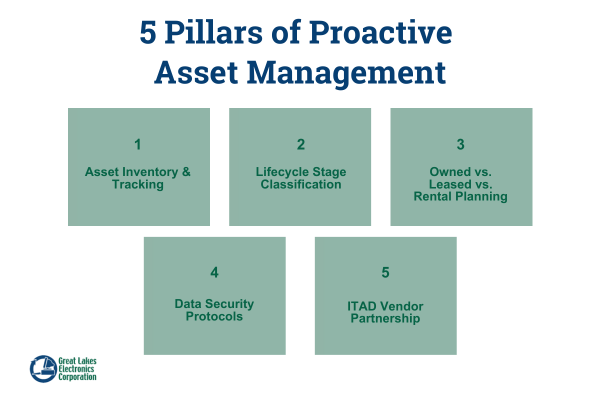
The 5 Pillars of Preemptive Data Center Asset Management
Effective data center asset management isn’t reactive. It’s built on five core disciplines that run from the day equipment arrives to the day it leaves.
1. Asset Inventory and Tracking from Day One
Every piece of equipment entering your data center should be tagged, cataloged, and tracked from the moment it’s received, not when it’s scheduled for retirement.
That means capturing serial numbers, rack locations, configuration details, warranty expiration dates, and ownership status (owned, leased, or rented) at procurement. This prevents “ghost assets”, equipment that’s been decommissioned or relocated but still carries depreciation costs on the balance sheet because nobody updated the records.
Accurate inventory also speeds up the disposition process significantly. When it’s time to retire a rack of servers, you shouldn’t be spending days figuring out what’s there and who it belongs to. That information should already be documented and current.
2. Lifecycle Stage Classification
Not all equipment in your data center is in the same phase of its useful life. A proactive asset management program classifies every device into clear lifecycle stages:
- Active — currently deployed and serving production workloads
- Underutilized — deployed but operating well below capacity
- Scheduled for refresh — approaching end-of-life or end-of-warranty
- Staged for disposition — removed from production, awaiting secure decommissioning
Each stage triggers different management actions and compliance checkpoints. Underutilized equipment might be redeployed to a lower-tier workload before retirement. Equipment scheduled for refresh needs data sanitization planning weeks or months before the actual swap. Staged equipment needs secure chain-of-custody documentation from the moment it leaves the rack.
3. Owned vs. Leased vs. Rental Equipment Planning
This is where many organizations create unintentional risk. Leased and rented data center equipment has different disposition obligations than equipment you own, but it often gets managed the same way.
Leased
These servers and networking gear come with return logistics requirements, lease-end audits, and contractual obligations around the condition of returned equipment. More critically, the data on that equipment is still your responsibility. If a leased server gets returned to the lessor without proper sanitization, you’ve created a data exposure event, regardless of who owns the hardware.
Rental
Rental equipment used for short-term capacity needs, disaster recovery staging, cloud migration support, and seasonal workloads introduces similar risk. These temporary deployments often bypass standard asset management workflows because they’re viewed as short-term. But a server processing sensitive data for 90 days carries the same data security obligations as one that’s been in the rack for five years.
The fix is straightforward: apply the same chain-of-custody and data destruction standards to leased and rented equipment as you do to owned assets. Build data sanitization milestones into lease return timelines. Document everything.
4. Data Security Protocols Before Equipment Leaves the Rack
NIST 800-88-compliant data sanitization isn’t just a disposal activity. It should be triggered by any change of custody, internal transfers between departments, redeployment to a lower-tier workload, lease returns, rental returns, and final decommissioning.
Before scheduling any equipment for removal, conduct a pre-disposition audit to verify what data exists on which drives. This step alone prevents the most common data security failures in decommissioning: the drives that “shouldn’t have had anything on them” but did.
Certificates of data destruction should be generated at every custody transfer point, not just at final disposal. This creates a documented chain of evidence that protects your organization in the event of an audit or a downstream data incident.
5. Early ITAD Vendor Partnership
Your IT asset disposition partner should be involved in the planning process well before equipment reaches end-of-life, not called in as an afterthought when you’ve already pulled the rack and need someone to haul it away.
A certified ITAD partner can assist with pre-disposition audits, residual value assessments, and compliance documentation planning months before a decommissioning event. This advance coordination reduces rush fees, maximizes asset recovery value, and ensures data security protocols are in place before the first device is powered down.
When evaluating ITAD vendors, look for R2 (Responsible Recycling) and ISO 14001 (Environmental Management) certifications. These ensure the vendor follows documented ITAD processes for secure data destruction, environmental compliance, and chain-of-custody tracking throughout the disposition process.
The Hidden Risks of Leased and Rented IT Equipment
Leased
Leased servers and networking gear are often treated as “someone else’s problem” when it comes to asset management, but the data on them is entirely yours.
When lease terms expire, organizations have a narrow window to sanitize, document, and return equipment. That compressed timeline leads to shortcuts:
- Drives that don’t get wiped
- Documentation that doesn’t get generated
- Chain-of-custody gaps that create compliance exposure
Rented
Rented equipment deployed for temporary capacity, cloud migration staging, disaster recovery events, and seasonal processing is even more vulnerable. These deployments frequently bypass standard asset management workflows entirely because they’re viewed as temporary.
But temporary doesn’t mean low-risk. Any device that processes or stores sensitive data, even briefly, requires the same sanitization and documentation rigor as a permanent asset.
The solution is to treat every device in your data center with the same asset management discipline, regardless of ownership status. Same tracking, same lifecycle classification, and same data destruction standards.
Your Data Center Asset Management Checklist

Use this as a quick-reference framework for evaluating your current program:
- Asset tagged and inventoried at procurement — not at retirement
- Lifecycle stage classification current — every device is assigned to active, underutilized, refresh, or disposition
- Lease and rental return dates calendared — with data sanitization milestones built into the timeline
- Data sanitization protocol mapped to NIST 800-88 — for every custody transfer, not just final disposal
- Certified ITAD vendor engaged for pre-disposition planning — months before decommissioning, not days
- Chain-of-custody documentation in place — for every transfer, return, or retirement event
- Residual value assessment completed — before equipment is written off or recycled
Partner with Great Lakes Electronics for End-to-End IT Asset Management
At Great Lakes Electronics, we work with data center operators across the full asset lifecycle, not just the disposal phase. Our team helps organizations build proactive asset management programs that
- Reduce risk
- Maintain compliance
- Maximize recovery value from retired IT infrastructure
We are R2v3 certified, ISO 14001 certified, and follow NIST 800-88 data sanitization standards. As a family-owned company operating since 2000, we serve organizations across Michigan, with nationwide pickup available for large-scale data center decommissioning projects.
Whether you’re planning a single-rack retirement or a full-facility decommission, we can help you build a strategy that protects your data, your compliance posture, and your bottom line.
Contact our team to discuss your data center IT asset management needs.
Frequently Asked Questions
What is data center IT asset management?
Data center IT asset management is the process of tracking, maintaining, and planning for every piece of IT equipment in a data center from the moment it is procured through its active service life and eventual retirement.
How is IT asset management different from IT asset disposition?
IT asset management covers the entire lifecycle of equipment, including procurement, deployment, and ongoing tracking. IT asset disposition focuses specifically on the end-of-life phase, which includes secure data destruction, recycling, and remarketing. Effective asset management throughout the lifecycle makes the disposition process faster, more cost-effective, and more compliant.
What happens to data on leased or rented data center equipment?
Data on leased or rented equipment remains your organization’s responsibility, even though you do not own the hardware. Before returning leased servers or networking gear, all data-bearing devices should be sanitized to NIST 800-88 standards. You also need certificates of destruction generated to document compliance and protect your organization from liability.
Why should an ITAD vendor be involved before equipment reaches end-of-life?
Engaging a certified ITAD partner early allows for pre-disposition audits, residual value assessments, and compliance documentation planning well before decommissioning begins. This advance coordination reduces rush fees, maximizes asset recovery returns, and ensures all data security and environmental protocols are in place before the first device is powered down.
What certifications should a data center ITAD partner have?
Look for R2 (Responsible Recycling) and ISO 14001 (Environmental Management) certifications. These ensure the vendor follows documented, auditable processes for secure data destruction, environmental compliance, and full chain-of-custody tracking throughout the disposition process. Compliance with NIST 800-88 data sanitization standards is also critical for organizations handling sensitive information.